
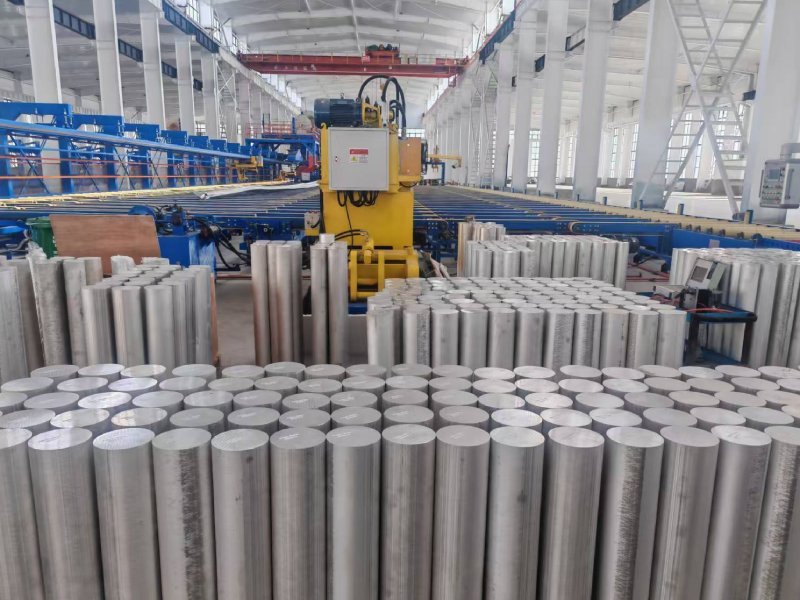
A wrought magnesium alloy is a magnesium-based engineering material shaped primarily through mechanical deformation rather than used directly in its cast form. After being melted and cast into a billet, slab, or bar, the alloy is further processed by extrusion, rolling, forging, drawing, or related thermomechanical operations. The word “wrought” therefore describes the manufacturing route, not one specific chemical composition.
This distinction matters because processing strongly affects a magnesium component’s internal structure and performance. Cast magnesium alloys solidify inside a mold and may contain coarse grains, segregation, shrinkage defects, or porosity. Wrought processing compresses and reshapes the starting material, refines its grains, redistributes second-phase particles, and can reduce certain internal defects. Wrought magnesium alloys can consequently provide better strength, ductility, fatigue resistance, and structural reliability than comparable as-cast materials.
Why Magnesium Is Used as a Structural Metal
Magnesium is one of the lightest metals commonly used for load-bearing engineering components. Pure magnesium has a density of approximately 1.74 g/cm³, making it much lighter than aluminum and steel. Its low density creates an attractive strength-to-weight ratio and makes magnesium useful wherever reducing mass improves energy efficiency, movement, payload, handling, or ergonomics.
Weight reduction is especially valuable in transportation equipment, aircraft, robotic systems, portable electronics, power tools, and high-speed machinery. A lighter component can reduce inertia, lower operating energy, improve acceleration, and decrease loads on surrounding structures. Magnesium also offers good machinability, effective vibration damping, and useful electromagnetic-shielding performance.
Pure magnesium is not strong or corrosion-resistant enough for many demanding applications. Manufacturers therefore add elements such as aluminum, zinc, manganese, zirconium, calcium, tin, yttrium, gadolinium, neodymium, or other rare-earth elements. These additions can refine grains, form strengthening precipitates, improve thermal stability, influence texture, and modify corrosion behavior.
How Wrought Magnesium Alloys Are Manufactured
Production normally begins with melting and primary casting. The molten alloy may be cast into a billet for extrusion or forging, or into a slab for rolling. The cast stock is often homogenized before deformation to reduce chemical segregation and dissolve selected second phases, helping the material deform more uniformly.
Because magnesium has a hexagonal close-packed crystal structure, it has fewer easily activated slip systems at room temperature than aluminum. Conventional magnesium alloys can therefore show limited room-temperature formability. Industrial deformation is commonly performed at elevated temperatures, where more deformation mechanisms become active and cracking is less likely.
During hot extrusion, a heated billet is forced through a die to produce bars, tubes, profiles, or complex constant-cross-section parts. Extrusion can refine grains and improve mechanical properties, although the result depends on temperature, speed, die design, and extrusion ratio. Experimental work on AZ31 has shown that increasing the extrusion ratio can produce finer grains and better room-temperature mechanical properties.
Rolling manufactures sheet, strip, and plate by passing the material between rotating rolls in several stages. Temperature, reduction per pass, reheating, and intermediate annealing must be carefully controlled because they affect cracking, recrystallization, grain size, and crystallographic texture.
Forging shapes a heated billet through compressive force using dies, presses, or hammers. It is suitable for structural parts that need directional grain flow, local reinforcement, or geometries not efficiently produced by extrusion. Other methods include caliber rolling, drawing, equal-channel angular pressing, multidirectional forging, and continuous or shear-assisted processing.
Microstructure, Texture, and Dynamic Recrystallization
One of the most important effects of wrought processing is grain refinement. When magnesium is deformed at a suitable temperature, dynamic recrystallization may occur. New, relatively strain-free grains form during deformation and replace parts of the elongated or heavily worked structure. Finer, more uniform grains can improve both strength and ductility.
Performance is not controlled by grain size alone. Wrought magnesium alloys often develop crystallographic texture, meaning many grains become oriented in similar directions. A strong basal texture commonly forms during rolling or extrusion. This preferred orientation can cause anisotropy, so yield strength, ductility, and deformation behavior may vary with the loading direction.
Texture is one reason magnesium sheet can be harder to form at room temperature than aluminum sheet. Alloy designers attempt to weaken or modify basal texture through rare-earth or calcium additions, controlled recrystallization, special rolling routes, asymmetric deformation, and optimized heat treatments. Research comparing AZ31, M1, and rare-earth-containing ME10 showed that alloy composition can substantially change extrusion texture and mechanical response.
Common Wrought Magnesium Alloy Families
Wrought grades are commonly identified by letter-number designations linked to their principal alloying elements. Exact properties depend on chemistry, product form, processing history, and heat-treatment condition.
AZ-series alloys contain aluminum and zinc. AZ31 is one of the most widely used wrought magnesium alloys and is available as sheet, plate, bar, and extrusion. It offers a practical balance of formability, strength, availability, and cost. AZ61 and AZ80 contain more alloying additions and may provide higher strength, although processing can be more demanding.
ZK-series alloys are based mainly on zinc and zirconium. ZK60 is a familiar high-strength wrought grade used for extrusions and forgings. Zirconium is an effective grain refiner in magnesium alloys without significant aluminum. ZK alloys can offer strong mechanical performance, but corrosion must be managed through purity control, heat treatment, surface protection, and component design.
WE-series alloys usually contain yttrium and rare-earth elements. WE43 retains useful strength at elevated temperatures and is used in demanding aerospace, motorsport, and specialized applications. Rare-earth-containing alloys can also develop weaker or more favorable textures, improving formability and reducing anisotropy. Their disadvantages include higher raw-material cost and more complex processing.
Other systems include Mg-Mn, Mg-Zn-rare-earth, Mg-Gd, Mg-Y, Mg-Ca, and Mg-Sn. Current research increasingly aims to obtain high strength, ductility, corrosion resistance, and processability with smaller amounts of costly alloying elements.
Mechanical Properties and Design Advantages
The properties of wrought magnesium alloys vary widely and depend on grain size, texture, precipitates, dislocation density, residual stress, temperature, strain rate, and loading direction. Extrusion, forging, or severe plastic deformation can raise strength by refining grains and controlling secondary phases. Heat treatment can further improve performance by dissolving unwanted phases or creating fine strengthening precipitates.
Compared with many cast products, wrought products generally have a more uniform microstructure. This makes them attractive for components exposed to cyclic loads, impact, vibration, or demanding dimensional requirements. Extruded sections can combine low weight with efficient geometry, while forged parts can align grain flow with critical load paths.
Magnesium’s elastic modulus is lower than that of aluminum or steel, so direct substitution may not provide enough stiffness. Engineers often compensate by changing the cross-section, adding ribs, using hollow profiles, or redesigning the assembly. The real advantage is not simply replacing another metal with the same shape, but designing around magnesium’s low density.
Corrosion and Surface Protection
Corrosion is a major limitation of magnesium alloys. Magnesium is electrochemically active, and attack can accelerate in salts, moisture, unsuitable coatings, or galvanic contact with more noble metals. Iron, nickel, and copper impurities can also be harmful at low concentrations.
Corrosion behavior is closely connected to microstructure. Grain boundaries, precipitates, inclusions, and composition differences can create local electrochemical cells. Research on ZK60 has shown that heat treatment changes second-phase distribution and micro-galvanic effects, significantly altering corrosion performance. Fine grains do not automatically guarantee better corrosion resistance; processing must balance mechanical strengthening with electrochemical uniformity.
Protection methods include conversion coatings, anodizing, micro-arc oxidation, electroplating, organic coatings, paints, sealants, and careful joint isolation. Designers should prevent water traps, avoid direct contact with incompatible metals, select suitable fasteners, and specify realistic environmental testing. Research has demonstrated that plasma electrolytic oxidation and additional coating layers can improve the corrosion protection of wrought magnesium grades such as AZ31B and WE43.
Applications of Wrought Magnesium Alloys
Wrought magnesium alloys are used in aerospace brackets, aircraft interior structures, gearbox housings, seat frames, automotive extrusions, steering components, bicycle parts, camera bodies, laptop enclosures, sporting equipment, medical devices, robotic structures, satellite hardware, and high-performance machinery.
Extruded profiles are attractive for long, lightweight structural members. Rolled sheet is considered for panels, enclosures, covers, and formed assemblies. Forgings suit wheels, brackets, hubs, and other highly loaded parts. In aerospace and space systems, high-performance magnesium alloys can reduce mass or improve payload capacity when corrosion, fatigue, flammability, and temperature requirements are properly controlled.
Limitations and Future Development
Wrought magnesium remains more difficult and sometimes more expensive to process than conventional aluminum. Challenges include limited room-temperature formability, strong texture, anisotropy, oxidation during hot processing, corrosion sensitivity, joining difficulties, and a smaller supply base.
Development now focuses on low-alloy compositions, rare-earth-free alternatives, high-speed extrusion, improved sheet formability, advanced forging, recycled feedstock, stronger corrosion protection, and better control of texture and recrystallization. New processing routes seek finer grains and more favorable textures while reducing energy use and cost.
Conclusion
A wrought magnesium alloy is a magnesium-based material whose final properties are created through both alloy chemistry and mechanical working. Extrusion, rolling, forging, and related processes transform cast stock into refined products with improved strength, ductility, consistency, and design potential.
Its greatest advantage is low weight, but successful use requires more than selecting a grade. Engineers must consider texture, loading direction, forming temperature, heat treatment, corrosion protection, joining, fatigue, and stiffness. When the alloy and process are correctly matched to the application, wrought magnesium can provide an exceptional combination of lightness, mechanical performance, machinability, and engineering efficiency.